
How to Understand Flow Rate, Head, and Horsepower When Selecting a Submersible Pump
How to Understand Flow Rate, Head, and Horsepower When Selecting a Submersible Pump
Flow rate, head, and horsepower are three common specifications used when selecting a submersible pump. Flow rate indicates how much liquid a pump can deliver over a given period, while head represents the vertical difference, pipe friction, and other system conditions the pump must overcome. Horsepower is one of the pump’s power ratings, but it does not directly indicate flow rate or head. When selecting a submersible pump, first determine the required flow rate and head. Then check the pump performance curve to confirm whether the pump can deliver the required flow rate at that head. Pump selection should not be based only on horsepower, maximum flow rate, or maximum head.
|
Specification |
Simple explanation |
Common units |
|
Flow rate |
How much liquid needs to be delivered over a given period? |
m³/hr, m³/min |
|
Head |
What vertical difference and piping resistance must the pump overcome? |
m, ft |
|
Horsepower / Power |
One of the pump’s power ratings |
HP, kW |
What Is Flow Rate?
Flow rate is the volume of liquid a pump
delivers over a given period.
For initial pump selection, estimate the required flow rate by determining how much liquid must be delivered and how quickly the task needs to be completed.
For example, if a drainage site needs to remove 100 m³ of water within 2 hours:
100 m³ ÷ 2 hr = 50 m³/hr
The initial flow rate requirement is
therefore approximately 50 m³/hr.
However, selecting a pump with a maximum flow rate above 50 m³/hr is not enough. The actual flow rate a pump can deliver also depends on the required head and the piping conditions at the site. A pump performance curve shows the head corresponding to different flow rates and helps determine how much flow the pump can deliver at a specific head.
What Is Head?
Head is not simply how high the water must be lifted. It represents the overall conditions the pump must overcome to deliver the liquid and is commonly expressed in meters (m). The required head depends not only on the vertical difference but also on resistance caused by pipe length, pipe diameter, elbows, and valves. Therefore, two sites with the same vertical difference may require different head values if their pipe lengths, diameters, or layouts are different. In simple terms, the distance from the water surface to the discharge point should not be treated as the complete head requirement.
Does Higher Horsepower Always Mean Higher Flow Rate and Head?
Not necessarily.
Horsepower is one of a pump’s power ratings; by itself, it does not indicate the flow rate or head a submersible pump can deliver. Even two submersible pumps with the same horsepower may have different flow rate and head ranges because of differences in impeller type, hydraulic design, solid passage, material, and operating environment. Likewise, higher horsepower does not mean that a pump will deliver a higher flow rate or head under every operating condition. A pump should not be selected based on horsepower alone. Actual performance must be evaluated using the specifications and performance curve for the relevant pump model.
Why Should Flow Rate and Head Be Considered Together?
On a pump performance curve, the same pump produces a different head at each flow rate. Flow rate and head must therefore be evaluated as one set of performance conditions, not as separate specifications.
The key pump selection question is:What flow rate can this pump deliver at the required head?
If you check only whether the maximum flow rate is sufficient without accounting for the vertical difference and pipe friction, the pump may not deliver the expected flow rate under actual site conditions. Similarly, maximum head alone does not show whether the pump can meet the required flow rate.
Can Maximum Flow Rate and Maximum Head Be Achieved at the Same Time?
In general, maximum flow rate and maximum head cannot be achieved under the same operating condition.
On a pump performance curve, maximum head is typically located near zero flow, while maximum flow rate is typically located at a lower head. The two maximum values therefore cannot be combined as one set of performance data.
For example, if the product data lists a maximum head of 25 m and a maximum flow rate of 80 m³/hr, this does not mean the pump can still deliver 80 m³/hr at a head of 25 m.
When selecting a pump, confirm whether it
can provide sufficient flow rate at the required head instead of comparing only
maximum flow rate and maximum head.
How Do I Check Flow Rate and Head on a Pump Performance Curve?
Locate the required head on the pump performance curve and check the corresponding flow rate. This shows whether the pump can meet both requirements simultaneously. Using the previous drainage example, if a site needs to remove 100 m³ of water within 2 hours, the initial flow rate requirement is approximately 50 m³/hr. If the required head is determined to be 12 m after evaluating the vertical difference and piping conditions, do not check only the pump’s maximum flow rate. Use the performance curve to confirm:Can the pump deliver approximately 50 m³/hr at a head of 12 m?
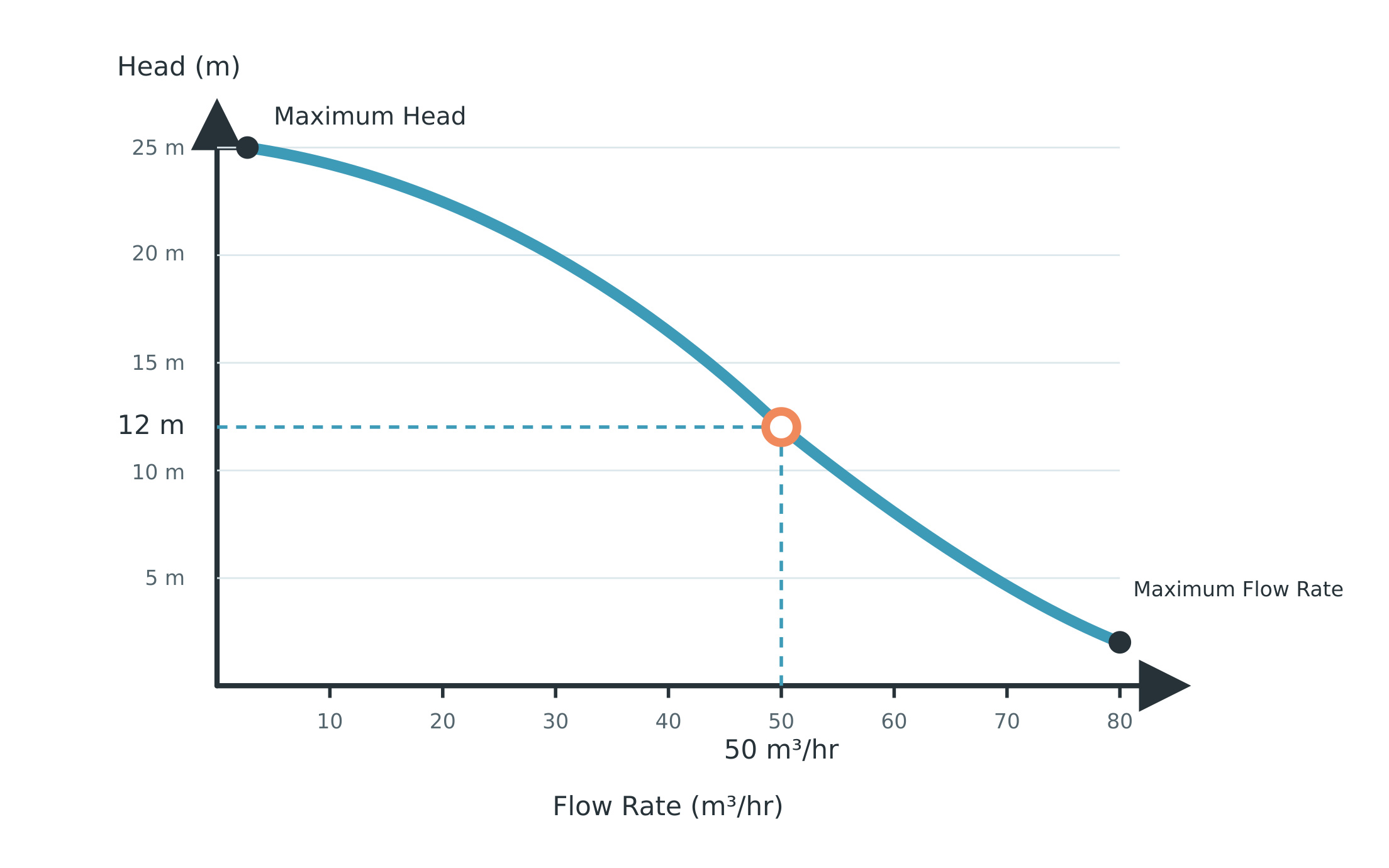
Illustrative pump performance curve. Values are for reference only and do not represent any specific HCP model.
If the performance curve shows that the pump can deliver 50 m³/hr at a head of 12 m, this flow rate and head combination meets the initial requirement. After confirming the required flow rate and head, also evaluate the type of liquid, whether it contains solid particles or other entrained material, the power supply, material requirements, and the installation environment.
When Selecting a Submersible Pump, Should I Check Flow Rate, Head, or Horsepower First?
Start by determining the required flow rate and head. Then identify a suitable product series and model based on the pumped liquid, application, and installation environment. Horsepower should be evaluated as one of the product specifications.
For initial pump selection, check the following in order:
1. Flow rate requirement: How much liquid needs to be delivered, and how quickly?
2. Head requirement: What vertical difference, pipe friction, and other system conditions must the pump overcome?
3. Pumped liquid: Does it contain solid particles, sand, fibers, wastewater solids, or corrosive substances?
4. Performance range: Can the pump deliver the required flow rate at the required head?
5. Other conditions: Confirm the horsepower, power supply, material, and installation environment.
Depending on the product series and model, HCP product data may include horsepower, flow rate, head, impeller type, solid passage, materials, and other specifications. When comparing HCP submersible pumps, check the performance data for the relevant model rather than comparing horsepower or maximum values alone. When selecting an HCP submersible pump, evaluate the application, pumped liquid, flow rate, head, power supply, and installation environment together to identify a suitable product series and model.
If you have not yet determined the appropriate product series, refer to “How do I choose the right HCP submersible pump for my application?”Then select a model based on the actual flow rate, head, and operating conditions.

